Table of Contents
- What Makes Silicone Baking Mats Worth Using
- Parchment Paper vs Silicone Baking Mats: Which Wins?
- Silicone Baking Mat Temperature Limit and Oven Safety
- Best Uses for Silicone Baking Mats in Your Kitchen
- How to Clean Silicone Baking Mats and Keep Them Lasting
- Storage, Organization, and Long-Term Durability
- Sustainability Lifecycle: The Eco-Friendly Case for Silicone Mats
- Conclusion
Last Updated: August 7, 2026
What Makes Silicone Baking Mats Worth Using
Silicone baking mats are reusable, non-stick baking surfaces made from food-grade silicone that replace parchment paper or greasing entirely. The case for silicone mats isn’t just convenience, it’s consistency. Bakers who switch report more even browning, fewer stuck items, and less cleanup time.
Food-Grade Silicone and Fiberglass Core Construction
A quality silicone baking mat combines food-grade silicone on the surface with a fiberglass core for structural stability. The fiberglass mesh prevents warping under heat, while the silicone coating delivers non-stick performance and heat resistance.
Food-grade silicone is a synthetic polymer that meets FDA standards for food contact materials, meaning it won’t leach chemicals into food under normal baking conditions. According to FDA guidance on food contact materials, materials used in food preparation must meet specific safety thresholds for chemical migration.
The fiberglass core also spreads thermal energy evenly across the baking surface, reducing hot spots that cause uneven browning on standard metal pans. This is why cookies baked on silicone mats come out uniformly golden rather than dark on the edges and pale in the center.
Non-Stick Surface and Even Heat Distribution
The non-stick surface requires no greasing. Metal conducts heat aggressively and unevenly, with areas directly above heating elements getting hotter than the rest. The fiberglass-reinforced silicone mat moderates direct heat and spreads it uniformly, resulting in more consistent caramelization across an entire batch.
Parchment Paper vs Silicone Baking Mats: Which Wins?
For most everyday baking tasks, silicone mats win on performance and long-term cost. Parchment paper wins on disposability for tasks like wrapping or steaming.
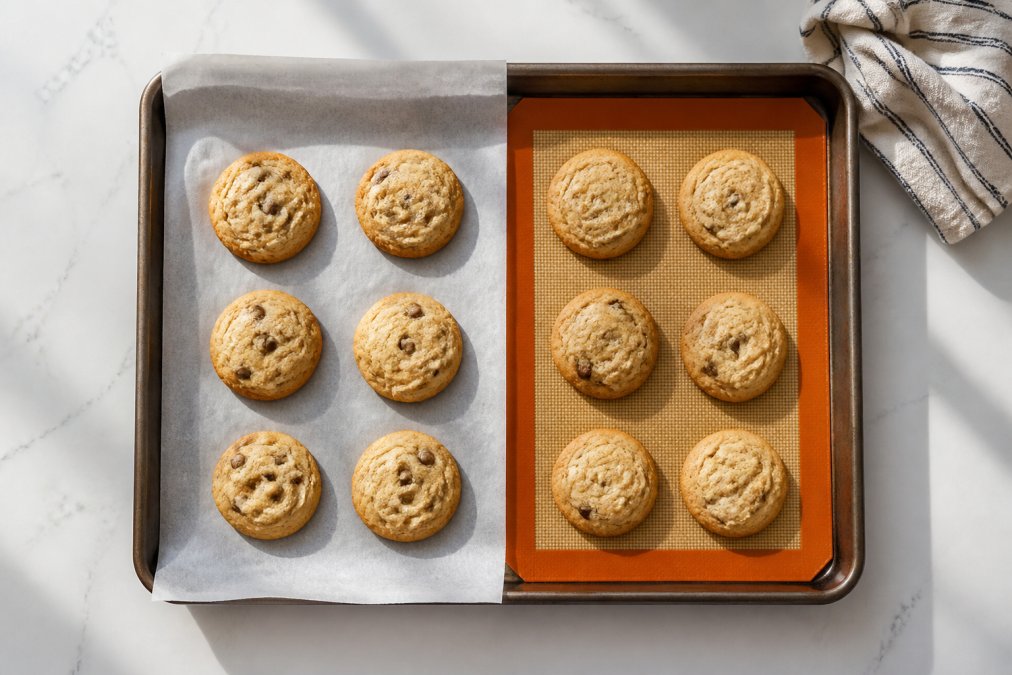
Parchment paper is slightly better for high-heat tasks above 450°F, where some silicone mats approach their upper limits. For the 350°F-425°F range covering most cookie, pastry, and bread baking, silicone mats match or exceed parchment performance.
Cost-Effectiveness and Waste Reduction Over Time
A single silicone baking mat can replace hundreds of sheets of parchment paper over its lifespan. Many quality mats hold up through thousands of uses with proper care. For a household that bakes weekly, the recurring cost of parchment paper adds up significantly, while a silicone mat pays for itself quickly and continues saving money.
| Factor | Silicone Baking Mat | Parchment Paper |
|---|---|---|
| Reusability | Thousands of uses | Single use |
| Upfront cost | Higher | Lower |
| Long-term cost | Lower | Higher |
| Non-stick | Yes, no greasing needed | Yes, minimal greasing |
| Heat resistance | Up to 480°F (varies by brand) | Up to 450°F |
| Eco-friendly | Yes (reusable) | No (disposable) |
| Best for | Cookies, candy, pastry | High-heat roasting, wrapping |
| Cleanup | Wash and reuse | Throw away |
Baking Performance: Browning, Caramelization, and Texture
Parchment paper produces slightly crisper cookie bottoms in some cases, though for chewy-centered cookies, the gentler heat from silicone is preferred. Caramelization on silicone mats is reliable and even. Sugar-heavy recipes like tuiles, florentines, and caramel candy benefit from uniform heat distribution, and delicate caramel-based confections release cleanly without tearing.
Silicone Baking Mat Temperature Limit and Oven Safety
The silicone baking mat temperature limit typically falls between 450°F and 480°F, though this varies by manufacturer. Most standard home baking takes place well within this range. Sustained exposure above the rated limit can cause material degradation, affecting both performance and safety.
Compatibility with Different Oven Types
Silicone baking mats work in standard conventional ovens and convection ovens without modification. In convection ovens, place the mat on a flat baking sheet to prevent shifting. Broiler use is off-limits, the intense direct heat can exceed a mat’s temperature threshold immediately and cause damage.
Specific compatibility notes:
- Convection ovens: Fully compatible on a baking sheet; expect slightly faster browning
- Conventional ovens: Ideal use case; consistent results
- Toaster ovens: Check mat dimensions and temperature rating carefully
- Broilers: Never use silicone mats under the broiler element
Signs of Material Degradation to Watch For
Watch for these degradation signs:
- Stickiness that won’t wash off: A mat that was previously non-stick and now leaves residue has reached the end of its useful life
- Discoloration that penetrates the surface: Deep yellowing or dark patches indicate material breakdown
- Visible cracks or tears: Any breach compromises integrity and creates areas where bacteria accumulate
- Persistent odors after washing: If odors remain after proper cleaning, the mat’s surface has degraded
- Warping or loss of structural shape: A mat that no longer lies flat has suffered heat damage
Never continue using a silicone mat that shows cracks, tears, or persistent stickiness. A damaged mat can transfer degraded material to food and no longer provides reliable non-stick performance. Replace it rather than risk your baking results or food safety.
Best Uses for Silicone Baking Mats in Your Kitchen
Silicone baking mats excel across a wider range of kitchen tasks than most people realize. The non-stick surface and even heat distribution make them ideal for anything where sticking or uneven cooking is a concern.
Cookies, Pastry Work, and Sticky Dough
Cookies are the obvious starting point. Drop cookies, rolled cookies, macarons, and meringues all benefit from consistent heat distribution and clean release. Macarons in particular are notoriously finicky, and many pastry professionals consider a quality silicone mat non-negotiable.
The smooth, non-stick surface is ideal for rolling out pie dough, puff pastry, and croissant dough directly on the mat. Many mats include measurement guides printed on the surface, making rolling dough to a precise diameter easier. Sticky dough like brioche and cinnamon rolls releases cleanly without the flour dusting needed on a countertop.
Candy Making, Kneading, and Beyond
Candy making is where silicone mats prove their versatility. Pulled sugar, toffee, brittle, and poured caramel all require a heat-resistant, completely non-stick surface. The candy simply peels off once cooled.
Kneading bread dough on a silicone mat is more efficient than on a bare countertop. The slight grip keeps dough from sliding while the non-stick quality means less flour is needed. Other uses include freezing individual portions before storage, lining dehydrator trays, and as a heat-resistant work surface for chocolate tempering.
For chocolate work, a silicone mat on a marble or granite surface creates an ideal tempering station. The silicone prevents the chocolate from bonding to the countertop while the cool stone beneath helps regulate temperature as you work.
How to Clean Silicone Baking Mats and Keep Them Lasting
Cleaning silicone baking mats correctly is what separates a mat that lasts years from one that degrades quickly. The process is simple, but common mistakes accelerate wear.
Dishwasher Safe or Hand Wash: What Works Best
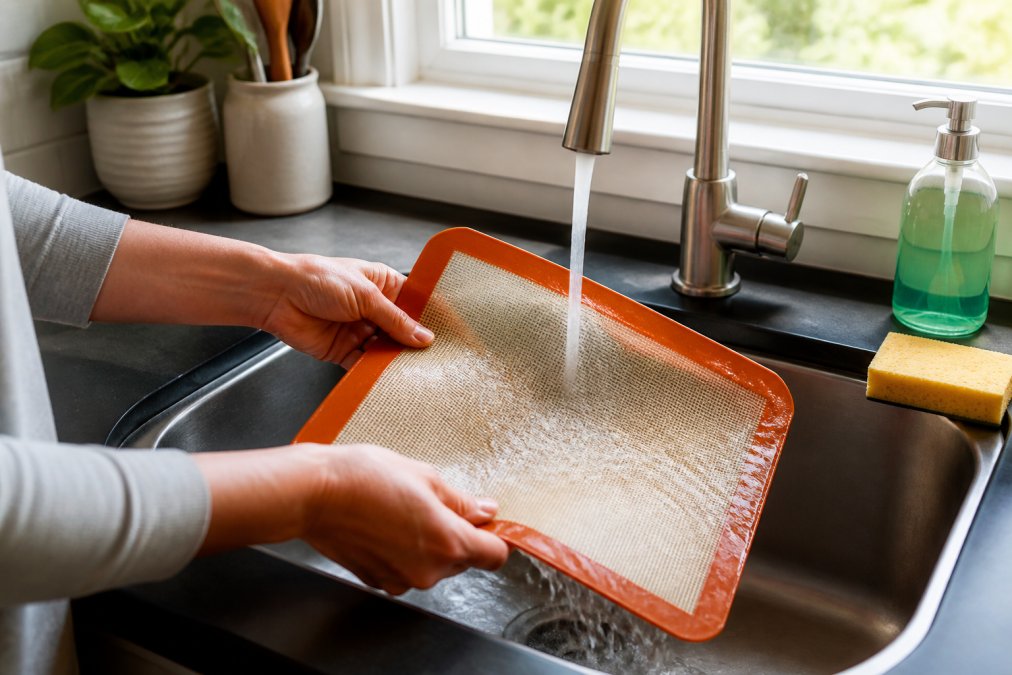
Most silicone baking mats are labeled dishwasher safe, but repeated high-heat cycles combined with harsh detergents accelerate surface degradation. Hand washing in warm water with mild dish soap extends mat life most effectively.
For routine cleaning:
- Allow the mat to cool completely
- Rinse under warm water to remove loose debris
- Apply mild dish soap to a soft sponge
- Wash gently in circular motions across the entire surface
- Rinse thoroughly until no soap residue remains
- Air dry flat; do not fold while wet
According to NSF International food safety guidelines, proper cleaning of reusable food contact surfaces requires thorough rinsing to remove all detergent residue.
Removing Residue and Odors Without Damaging the Surface
Baked-on grease and oil residue are the most common cleaning challenges. For stubborn residue, make a paste from baking soda and a small amount of dish soap, apply it to affected areas, let sit for 10-15 minutes, then scrub gently with a non-abrasive sponge and rinse thoroughly.
For persistent odors after baking with strong spices or seasonings, soak the mat in warm water and white vinegar for 20-30 minutes before washing.
Never use abrasive scrubbers, steel wool, or harsh chemical cleaners on silicone mats. These damage the surface texture, creating microscopic scratches where bacteria accumulate and permanently reducing non-stick performance.
Storage, Organization, and Long-Term Durability
Never fold a silicone mat. Repeated folding creates creases that eventually crack the fiberglass core, compromising structural integrity and the mat’s ability to lie flat during baking.
Practical storage options:
- Roll and store vertically: Roll the mat loosely and stand it upright in a container. This is the most space-efficient option.
- Flat storage in a baking sheet: Slide the mat into a sheet pan and store both together.
- Dedicated baking mat organizer: Store multiple mats vertically in slots without folding.
A well-maintained silicone mat from a reputable manufacturer should hold up through years of regular use. Treat the mat as the precision baking tool it is, and it will perform consistently for a long time.
Sustainability Lifecycle: The Eco-Friendly Case for Silicone Mats
The environmental argument for silicone baking mats is straightforward: reusable beats disposable on waste reduction. Parchment paper generates continuous single-use waste, while a silicone mat stays in use for years.
According to EPA guidelines on sustainable materials management, reducing the volume of single-use materials entering the waste stream is one of the most impactful individual-level sustainability actions available.
The honest caveat: silicone is not biodegradable, and most municipal recycling programs don’t accept it. The sustainability win comes entirely from the use phase, replacing hundreds of parchment sheets with a single mat. If a mat is discarded after only a few uses, the environmental math reverses.
Silicone baking mats represent a genuine sustainability upgrade over parchment paper when maintained properly and used for their full lifespan. Buying a quality mat and caring for it correctly reduces your kitchen’s environmental footprint.
For home bakers who want to take the eco-friendly approach seriously, the bon COOK baking collection is built around this philosophy: professional-grade tools designed to last, backed by guidance through live virtual cooking classes and the Base & Bloom baking system. As the Sustainable Packaging Coalition’s material guidance notes, the most sustainable product is the one that gets used to its full potential before replacement.
Silicone baking mats are one of the most straightforward upgrades a home baker can make, but only with quality materials and proper maintenance. bon COOK’s professional-grade bakeware combines durable construction with expert guidance through live virtual cooking classes and the Base & Bloom baking system. Get started with bon COOK and bake with the confidence that comes from having the right tools and the knowledge to use them.
Frequently Asked Questions
Are silicone baking mats better than parchment paper?
For most home bakers, silicone baking mats outperform parchment paper over time. They are reusable, require no greasing, and deliver consistent heat distribution that promotes even browning. Parchment paper is more convenient for tasks like lining irregular pans or wrapping food, but for standard sheet-pan baking, a quality silicone mat reduces waste and often produces more uniform results. The right choice depends on how frequently you bake and which tasks you prioritize.
Do silicone baking mats need to be greased?
No. The non-stick surface of food-grade silicone means you can place dough, cookies, or candy directly on the mat without butter, oil, or cooking spray. Skipping the grease also prevents excess browning on the bottoms of baked goods, which is a common problem with heavily greased parchment paper. If a recipe specifically calls for a greased surface, a very light coating is fine, but it is rarely necessary with a quality silicone baking mat.
Are silicone baking mats safe for high-heat baking?
Food-grade silicone baking mats are oven-safe up to around 480°F for most products, though the exact silicone baking mat temperature limit varies by brand and construction. The fiberglass core reinforces the mat and helps it hold its shape under heat. Avoid using them under a broiler or on a direct flame, as extreme temperatures beyond the stated threshold can cause material degradation. Always check the manufacturer's specifications before using a mat at high heat.
How do you clean and maintain silicone baking mats?
Rinse the mat with warm water immediately after use to prevent residue from setting. For stuck-on grease or odors, soak in hot water with a few drops of dish soap for 10 to 15 minutes, then scrub gently with a soft sponge. Most silicone baking mats are dishwasher safe, though hand washing tends to preserve the surface texture longer. Avoid abrasive scrubbers or sharp utensils, which can nick the surface and reduce the mat's non-stick performance over time.
Do cookies bake differently on silicone mats?
Yes, noticeably. Silicone mats insulate the bottom of cookies slightly more than bare metal pans, which slows the bottom browning and produces a softer, chewier base. If you prefer crispier cookie bottoms, parchment paper on a light-colored aluminum baking sheet may suit you better. For delicate cookies, macarons, or anything prone to sticking, silicone baking mats are a reliable choice because the non-stick surface releases baked goods cleanly without tearing.
Can you cut on a silicone baking mat?
No. Cutting directly on a silicone baking mat will slice through the surface and compromise its non-stick properties. The cuts can also create grooves where bacteria and food residue collect, making the mat harder to clean properly. Use a separate cutting board for any slicing or scoring tasks. Silicone mats are designed as baking surfaces and work well for kneading and rolling dough, but they are not a substitute for a proper cutting board.
This article was written using GrandRanker